What do our survey respondents look like?

What do our survey respondents look like so far?

Thank you
First, a big thank you to those 600+ of you who have taken the time to complete our survey. Yes, so far a remarkable 100% of those who started the survey completed it, spending an average of 35 minutes offering their thoughts and words. That everyone who has started the survey forged on to the very end is virtually unheard of in online survey research, especially with a long survey like ours which had 62 questions and encouraged written comments on most. Again, thank you to all the respondents for engaging our questions.

So, what do our survey respondents look like? They are dedicated, persevering, patient, and, based on the copious written responses, both thoughtful and generous.

As a research team we remain committed to hearing and reporting on your voices to the best of our ability.

A snapshot
Let’s take a deeper glance at what our survey respondents look like.

Mostly female
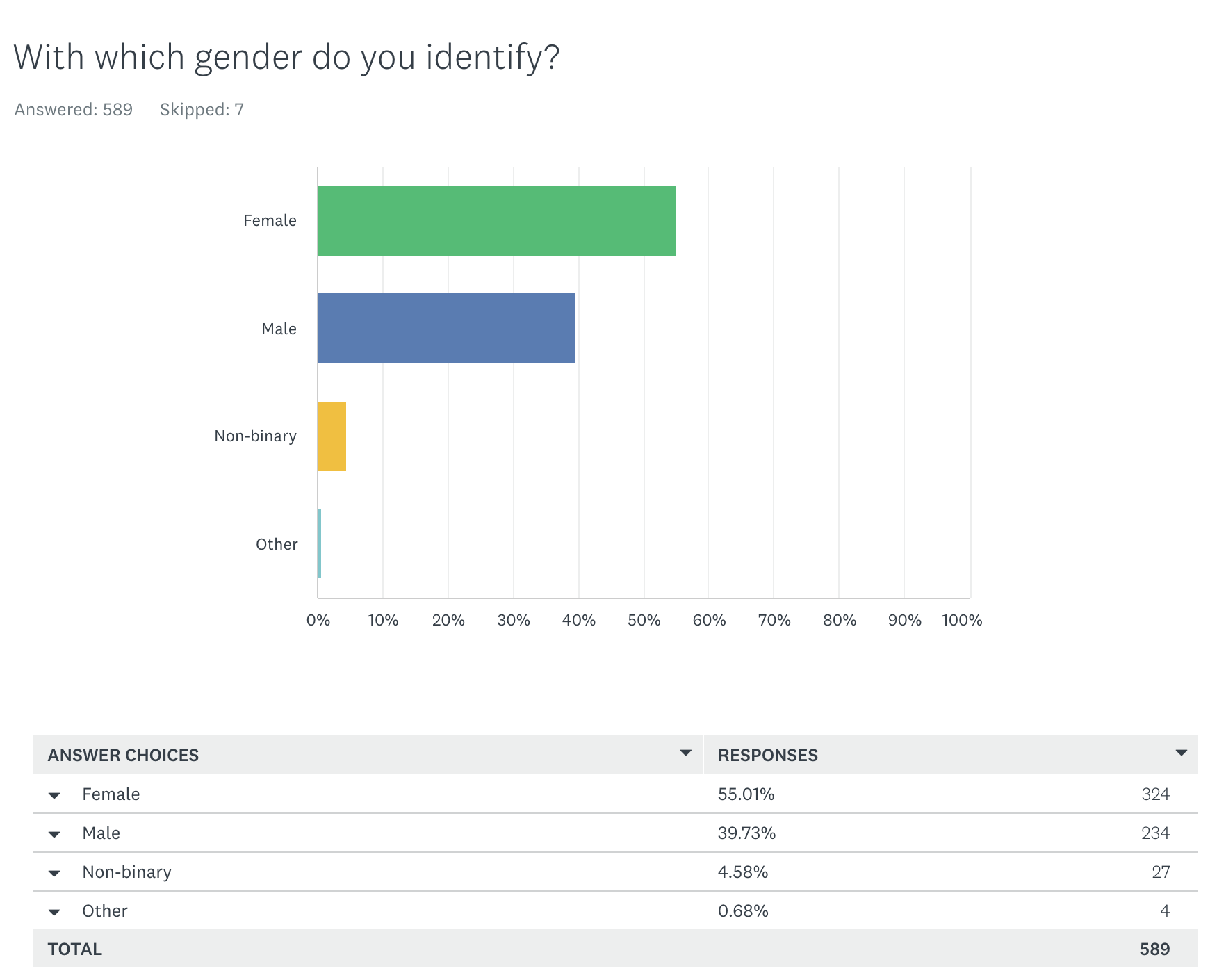
Our respondents are mostly female (55%), but with a good number of males (40%). Over 5% of the respondents checked ‘Non-binary’ or ‘Other’ indicating good gender identification diversity.

Well educated
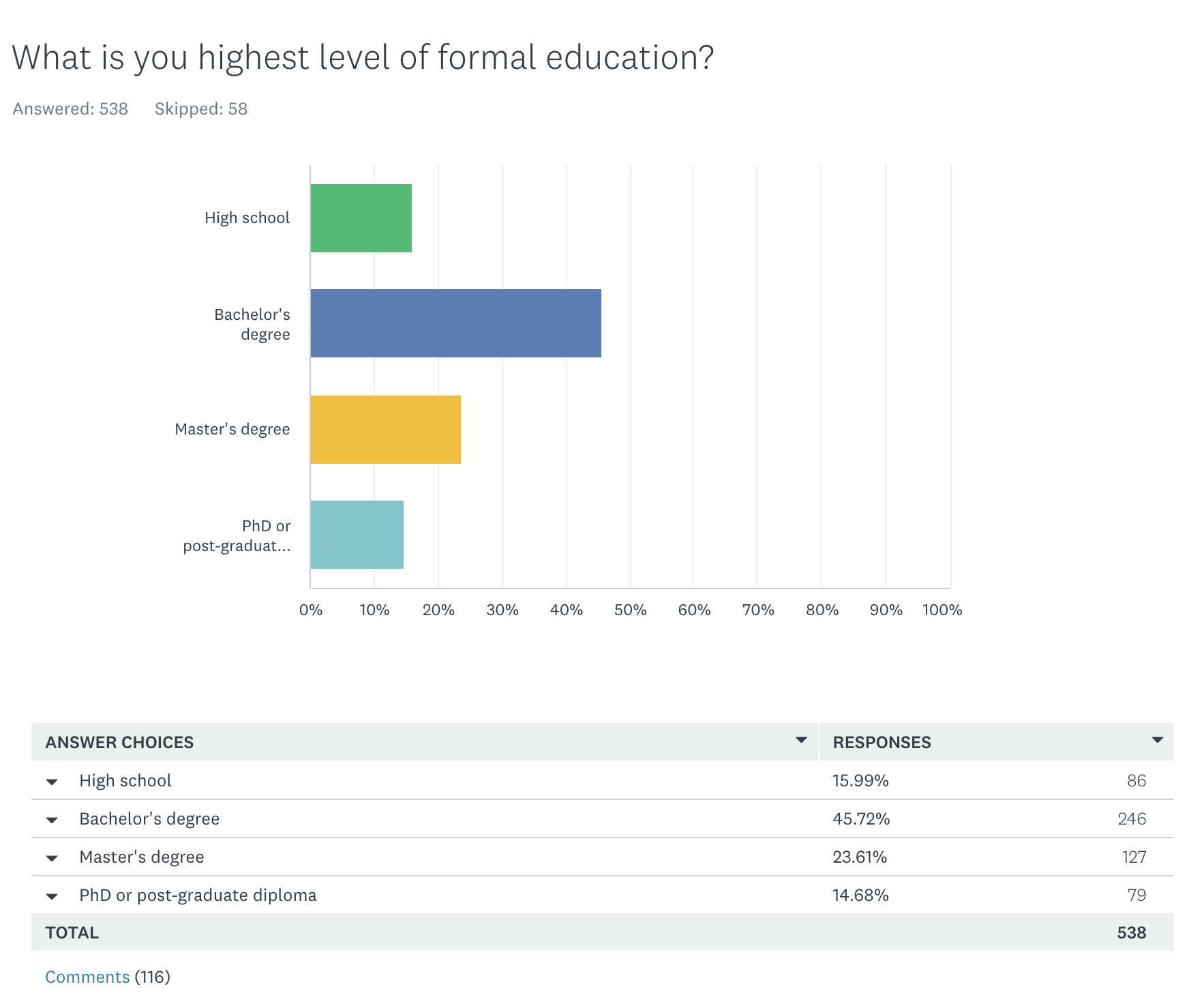
Our respondents appear to be well educated, with nearly 15% with a PhD or post graduate work. The level of education is apparent in not just the volume of comments we have received but more so in the overall clarity and thoughtfulness of what has been written.


Mostly millennial
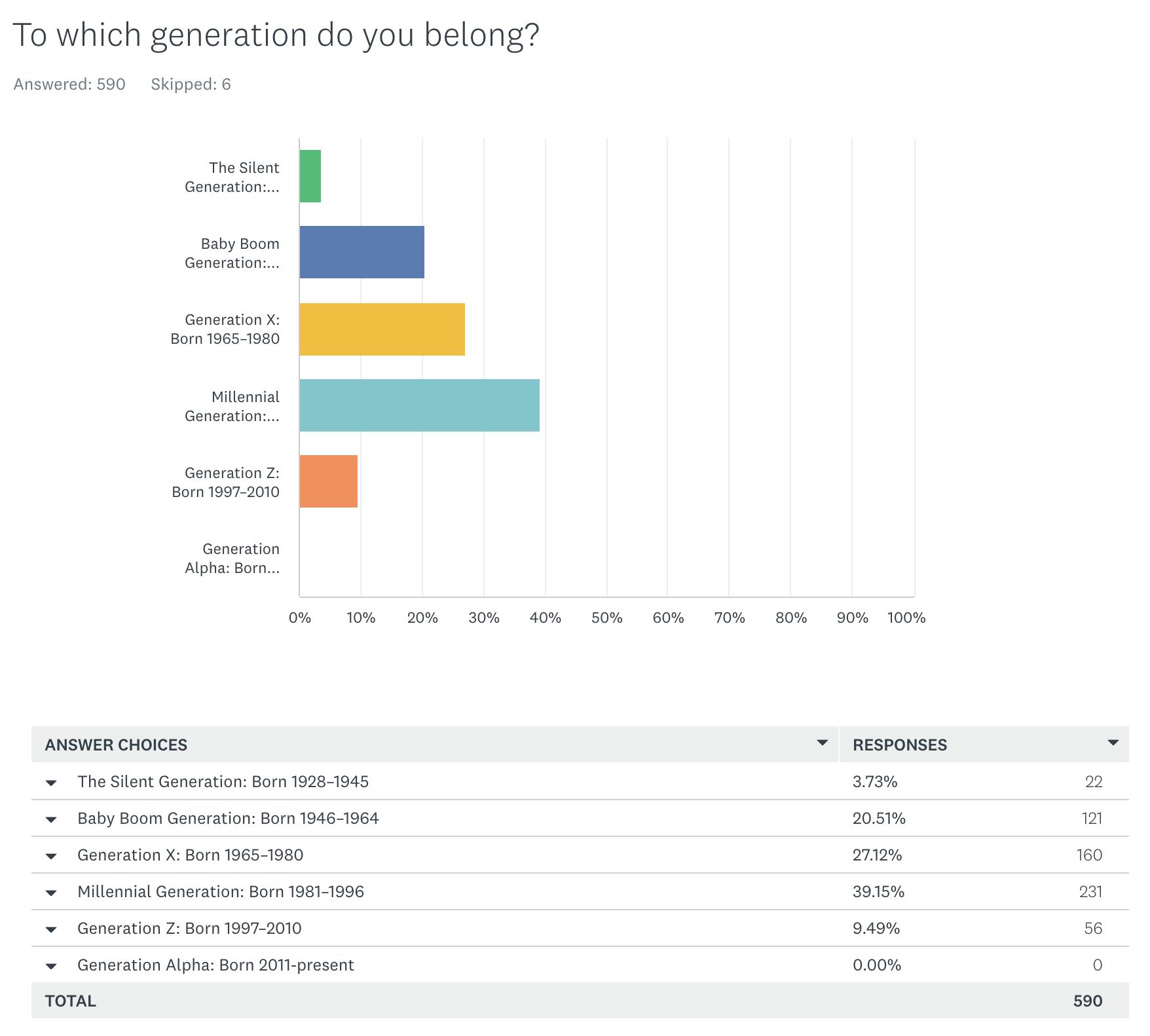
Our largest group are Millennials with 39%, but the older folk are well represented with Generation X at 27% and Boomers (like myself!) at 20%. The younger generations are lagging behind, with only 9% from Generation Z and none (as could be expected) from Generation Alpha.


From all over, but mostly the US
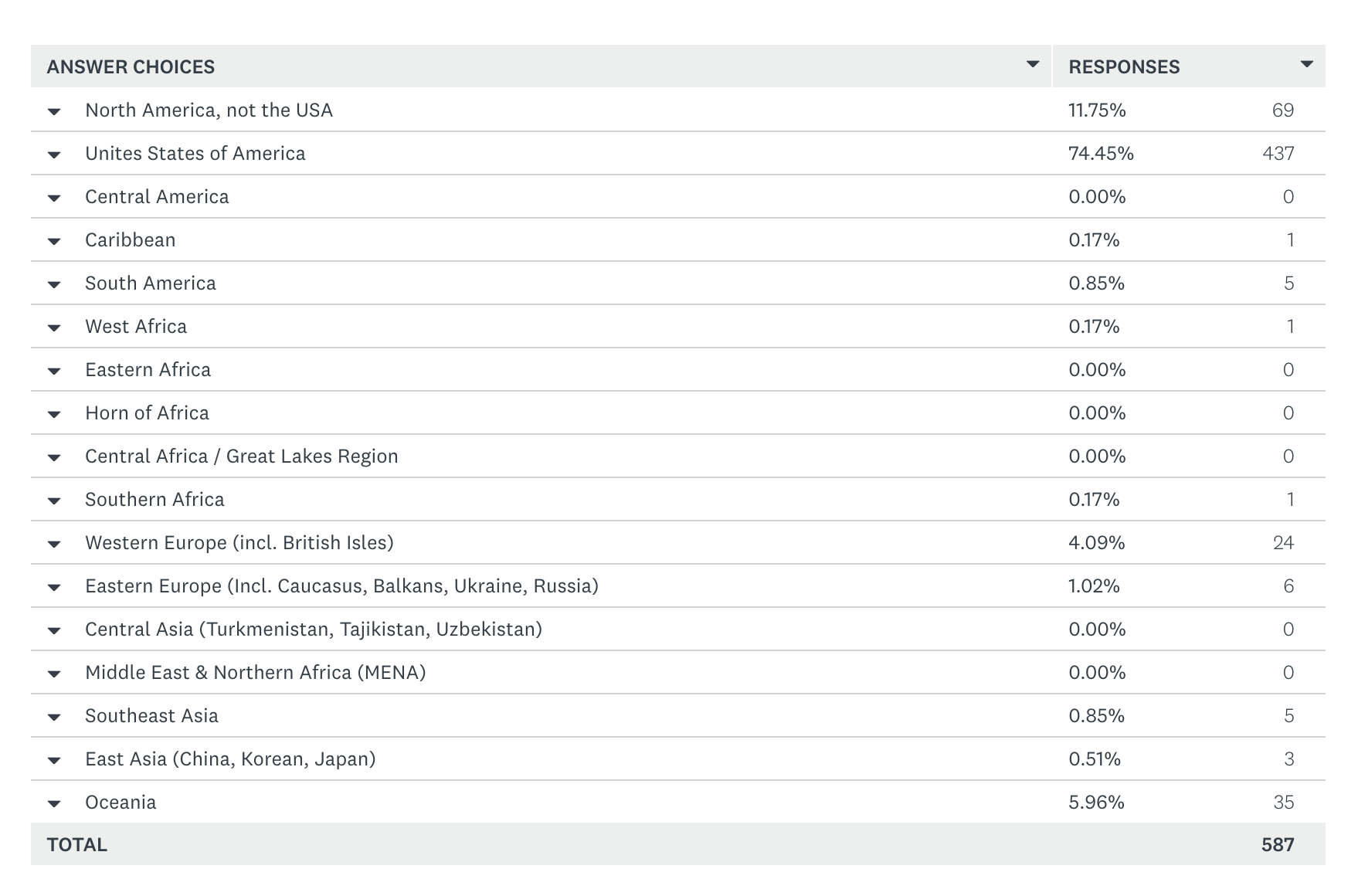
We asked, “In what region of the world do you currently live?” A larger majority of our respondents -74%- are from the USA and another 12% from Canada. The remainder of the respondents live in Oceania (6%), Europe (5%), with the remainder spread across the globe. Given evidence from the traffic on our blog site I think it safe to assume that the vast majority of those from Oceania hale from Australia.

Mostly white
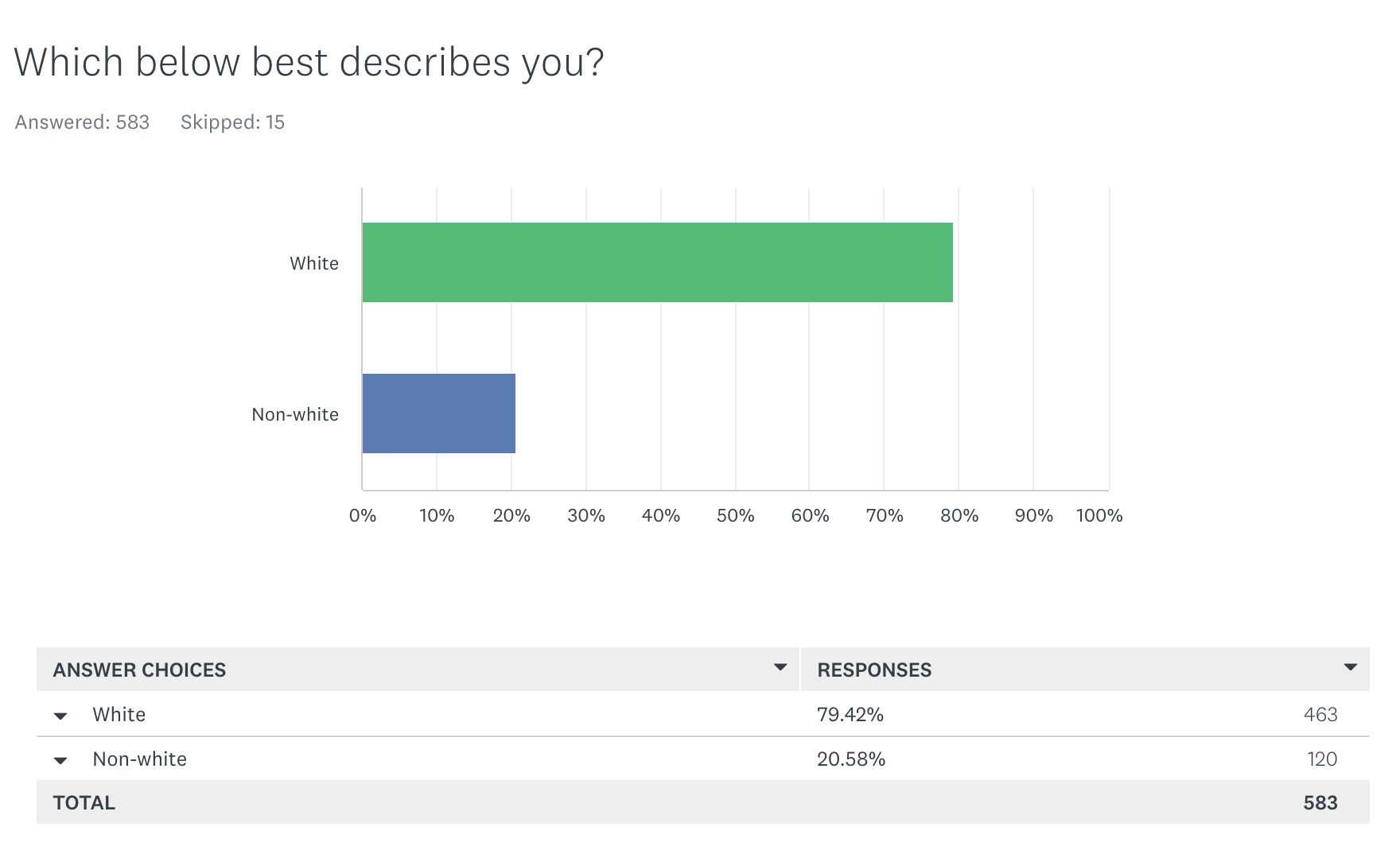
In a previous post titled “One size does not fit all” I explain our unique approach to the question of race. To this point in the data collection process our respondents are indeed overwhelmingly white. Perhaps as word of this survey gets out to different geographic and demographic groups we will see greater diversity. The responses to the question following “Which best describes you?” are fascinating thus far. This question asked, “Please use the space below to (1) react to the inappropriateness of the choices in the question above and (2) describe how you identify yourself based on common cultural-linguistic, ethnic, racial, tribal, national or other categories.” I’ll report more on these responses in a future post.


Traffic on the blog
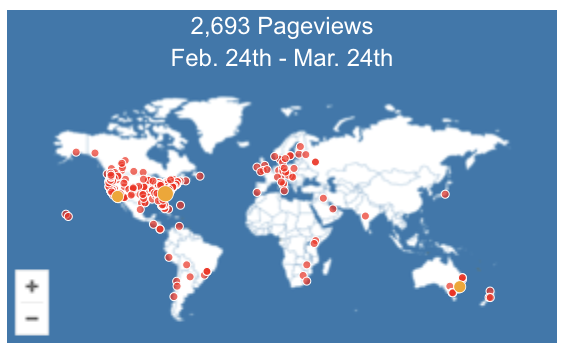
As of this writing we have had a modest number of people visit our blog (2,693) reading our updates and comment. Visitors are mostly from the USA but there have been site visits from 34 different countries and from every continent except for Antarctica.


All for now
That’s all for just now. I will be updating this post in the near future. In the meantime please feel free to reach out if have any comments or questions. I can be reached at arcaro@elon.edu.

Again, thank you to everyone who has become a part of this project.

Leaving the Church: An Individual Story

Leaving the Church: An Individual Story


Many leave their faith home
Many people, for whatever set of reasons, leave their church. A substantial subset of those also leave their faith, that is, they become atheists or, at least, agnostics. Many who have abandoned their church no doubt wonder about the experiences of others who have quit. Such an individual may ask, Did they suffer the same feelings of oppression, doubt, and skepticism that I felt? And what of those who remain? Do they experience these feelings and suppress them? Or do they not experience them at all? How many who remain in the church are on the verge of leaving? How many are just paying lip service when they go through all the rituals and so forth? How many remain for fear of being stigmatized if they show signs of non-conformity to the group? What are the church leaders thinking and doing behind closed doors? Answers to these questions are difficult to come by.

Fortunately, a leading Christian evangelist has given insight into one church, or more properly movement, the evangelical movement in the United States. For those who don’t know, evangelical Christianity embraces, among other things, the ideas of biblical inerrancy, the centrality of being “born again,” and the importance spreading the Christian message. Evangelicals are found in nearly every Protestant denomination. Wheaton College’s Institute for the Study of American Evangelicals estimates that their number in the U.S. is approximately 90 to 100 million people. So what we’re talking about is a massive movement with massive influence embracing massive numbers.

A leading evangelical pastor
Francis Schaeffer was a leading evangelical theologian, philosopher, and Presbyterian pastor on the American religious and political scene, particularly in the 1970s and early 1980s. He hobnobbed with prominent Christian leaders of the time, discussing religious issues and plotting strategy for advancing evangelical causes. Frank Schaeffer, the son of Francis Schaeffer, grew up immersed in a religious environment, attending religious functions, listening to religious discussions, and meeting important religious figures of the day. He became his father’s protégé and strategist, and was considered an up-and-coming evangelical leader in his own right.

Then he changed his mind. He looked around and decided he didn’t like what he saw in the evangelical movement. Turning his back on his background and his life’s work, he quit. In several works, he has written about his experiences. He tells of his growing dissatisfaction with the behavior of the leading evangelists of the day, such as Pat Robertson and Jerry Falwell. One book in particular is relevant here– Crazy for God: How I Grew Up as One of the Elect, Helped Found the Religious Right, and Lived to Take All (or Almost All) of It Back. I have pulled quotes from this book that give a telling portrait of the evangelical Christian movement, particularly of the 1970s and early 1980s. (I must add that although the book highlights events from decades ago, I doubt that much has changed in the 2020s.)

In his own words
One would think that American religious leaders, especially conservative ones (as the leading evangelists tended to be), would be hoping (and praying) for America’s success. After all, they are Americans, and Americans, especially conservatives, are conventionally thought to stand by their country. Well, in the case of evangelical Christian leaders, perhaps not. Frank Schaeffer writes:

“The leaders of the new religious right were different from the old secular right… They were gleefully betting on America’s failure. If secular, democratic, diverse, and pluralistic America survived, then wouldn’t that prove that we evangelicals were wrong about God only wanting to bless a “Christian America”? [p. 298-299]”

What about the horrible terrorist attacks on September 11, 2001? The World Trade Center was brought down. Thousands of American lives were lost. An attack was also made on the Pentagon, killing more. A failed terrorist attack resulted in a jet crash in Pennsylvania, killing all on board, including the terrorists. Surely the major evangelical leaders would try to console the nation in this time of grief. Again, no.

“And after 9/11, the public got a glimpse of anti-American self-righteous venom that was always just under the surface of the evangelical right. Pat Robertson, Jerry Falwell, and others declared that the attacks on America was punishment from God. [p. 299]”

What about the war with Iraq? Shouldn’t we honor our young people killed in combat? Perhaps not.

“And after the war in Iraq began, some loony group of fundamentalists started picketing the funerals of killed soldiers and screaming at bereaved fathers and mothers that God was punishing “faggot America.” What they shouted openly was what the leaders of the religious right were usually too smart to state bluntly, but it is what they had often said in private. [p. 299]”

The public, or at least the believing public, places great trust in the leaders of the evangelical movement now, as it did in the 1970s and 1980s. They are thought to be wise, honorable, decent, God-fearing, God-loving, Bible-abiding men. What is the opinion of the ultimate insider, Frank Schaeffer?

“The public image of the leaders of the religious right I met with so many times also contrasted with who they really were. In public, they maintained an image that was usually quite smooth. In private, they ranged from unreconstructed bigot reactionaries like Jerry Falwell, to Dr. [James] Dobson, the most power-hungry and ambitious person I have ever met, to Billy Graham, a very weird man indeed who lived an oddly sheltered life in a celebrity/ministry cocoon, to Pat Robertson, who would have a hard time finding work in any job where hearing voices is not a requirement. [p. 315]”

But perhaps these very public figures were exceptional in their quirkiness or badness. What did Frank Schaeffer think of the leaders more generally?

“There were three kinds of evangelical leaders. The dumb or idealistic ones who really believed. The out-and-out charlatans. And the smart one who still believed—sort of—but knew that the evangelical world was shit, but who couldn’t figure out any way to earn as good a living anywhere else. I was turning into one of those, having started out in the idealistic category. [p. 329]”

As his father aged and sickened, this icon of the evangelical movement became jaded. Frank reflects upon his father’s thoughts.

“Dad seemed lost in a depressed daze. He had recently been saying privately that the evangelical world was more or less being led by lunatics, psychopaths, and extremists, and agreeing with me that if ‘our side’ ever won, America would be in deep trouble. But by then Dad was dying and knew he had very little time left. There was no time to change his life or his new “friends.” [p. 335]”

Frank Schaeffer describes in his book his personal odyssey of disillusionment as the scales dropped from his eyes, as well as that of his father. Therein may lie lessons for others. He also describes the multiple moral failings of evangelical Christianity’s leaders. Surely those accounts should sound alarm bells for people of good conscience and clear thinking.

So there you have it. According to the ultimate insider of the movement and his father, a leader of the movement, evangelical Christianity, encompassing tens of millions of Americans and representing one of the most powerful voting blocs in the nation, during the 1970s and into the 1980s was being run to a large extent by psychologically damaged misfits or charlatans, with an agenda that would ultimately be destructive to America. And millions upon millions of Americans continue to believe.

Ex-SDA connection?
How does all this relate to ex-SDA’s and our survey? In many cases respondent comments have echoed Frank  Schaeffer’s sentiments. This post is part of our larger effort to put the survey data into a larger context and to make it even more meaningful to both of those who took the survey and are anxious to hear the full results and to the larger population interested in learning more about why some leave the church.


The cult question

“The SDA cult needs to be comprehensively exposed to as wide an audience of SDAs and non-SDAs as possible, and then be roundly and formally denounced by as many people and institutions as possible. E.G. White was likely a psychopathic con artist who may someday be viewed as one of the most impacting con artists in recorded history.”

-male Millennial survey respondent

The cult question

Strong words of accusation
Reading through the comments has been difficult and fascinating. As a sociologist I find most of the comments inherently interesting, of course, but reading some offerings has been difficult knowing that a real person spent time thinking about and writing those words. This comment from a Millennial male from the United States was particularly striking in its passion and deep conviction.

In response to Q27 “In as few or as many words as you like, please tell us about your process and experience of leaving Adventism.” he wrote,

“The SDA cult had a strong and lasting negative impact on me for many years after I internally denounced the faith. It has taken me decades to develop a deepened awareness of just how systematically diabolical this cult system is, how damaging it has been to me throughout my entire childhood and adult life, and how dangerous it is to the survival of the human race for Adventism to be allowed to continue to freely prey upon on its victims in the manner that it does. Adventism and the SDA educational system is, by design, a methodical, strategic brainwashing camp that actively employs shame-based cognitive, behavioral, and emotional mind-control techniques within its milieu in order to deeply indoctrinate its followers and their current and future offspring. This is particularly damaging to Adventist children and should meet the minimum legal threshold necessary to define some SDA practices as inherently abusive towards children, and yet it is somehow not defined or viewed that way socially or legally. The SDA cult needs to be comprehensively exposed to as wide an audience of SDAs and non-SDAs as possible, and then be roundly and formally denounced by as many people and institutions as possible. E.G. White was likely a psychopathic con artist who may someday be viewed as one of the most impacting con artists in recorded history. The harm that Adventism has caused and continues to cause globally is being vastly underrepresented and undervalued, and warrants significant further research and social, political, legal, ethical, psychological, and theological scrutiny.”
A cult?
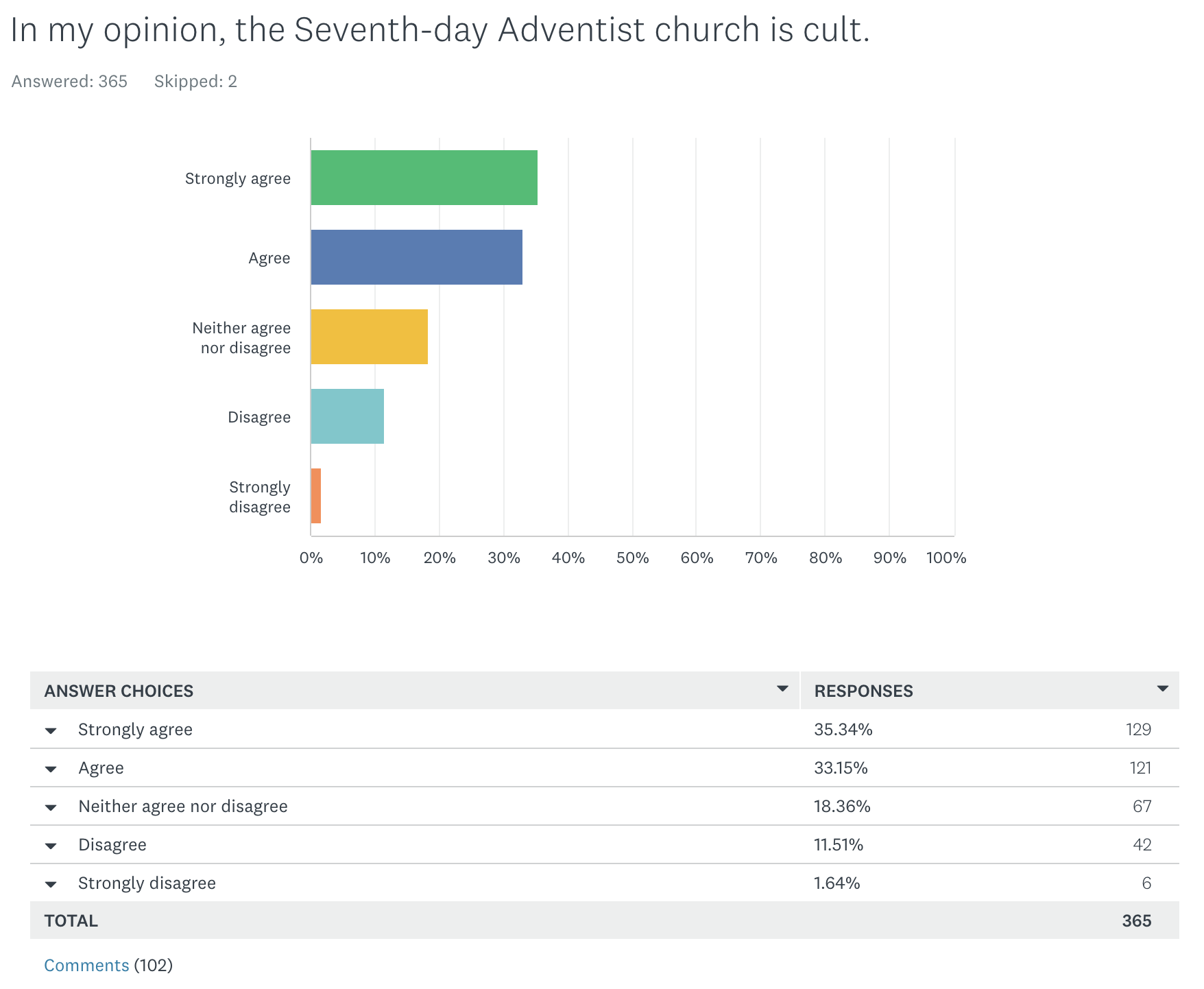
This respondent is not alone in referring to Adventism as a cult. As you can see from the the data below most- more than two thirds- of our respondents agree with this assessment.

“Cult-ish”
The binary of is or is not a cult is clearly not nuanced enough for many. One respondent viewed the word ‘cult’ as a smear.

“Every time I’ve heard the word cult used to describe a group, it’s been a smear attempt, so I don’t know how helpful the term is. The SDA church certainly can be a high control group, but the experience of such is so depended on where/when you interacted with it and who you were that it’s hard to give a global label like ‘cult.'”

But how do you define a cult? These next three comments dance around the term.

“The SDA church may be far reaching, but its insistence on absolute dedication, it’s thorough indoctrination of members from birth to college, shows it’s ability to keep members under control. The SDA church employs guilt, ridicule, harrassment, gaslighting…etc. to get members to stay. They use the “bait and switch” method to get new members. It sounds good when you’re studying with them, and then once you’re baptized, they start letting you know how you’re not ‘meeting standard’.”

“Not a cult in that you are technically free to leave whenever you’d like, but the mindset and community can feel extremely cult-like.”

“This depends on your definition of a cult. In some ways, it is. I don’t think it is officially considered one. It is a fun insult to hurl at Adventism anyway. Or at least to call it ‘cult-ish.'”

A misused term?
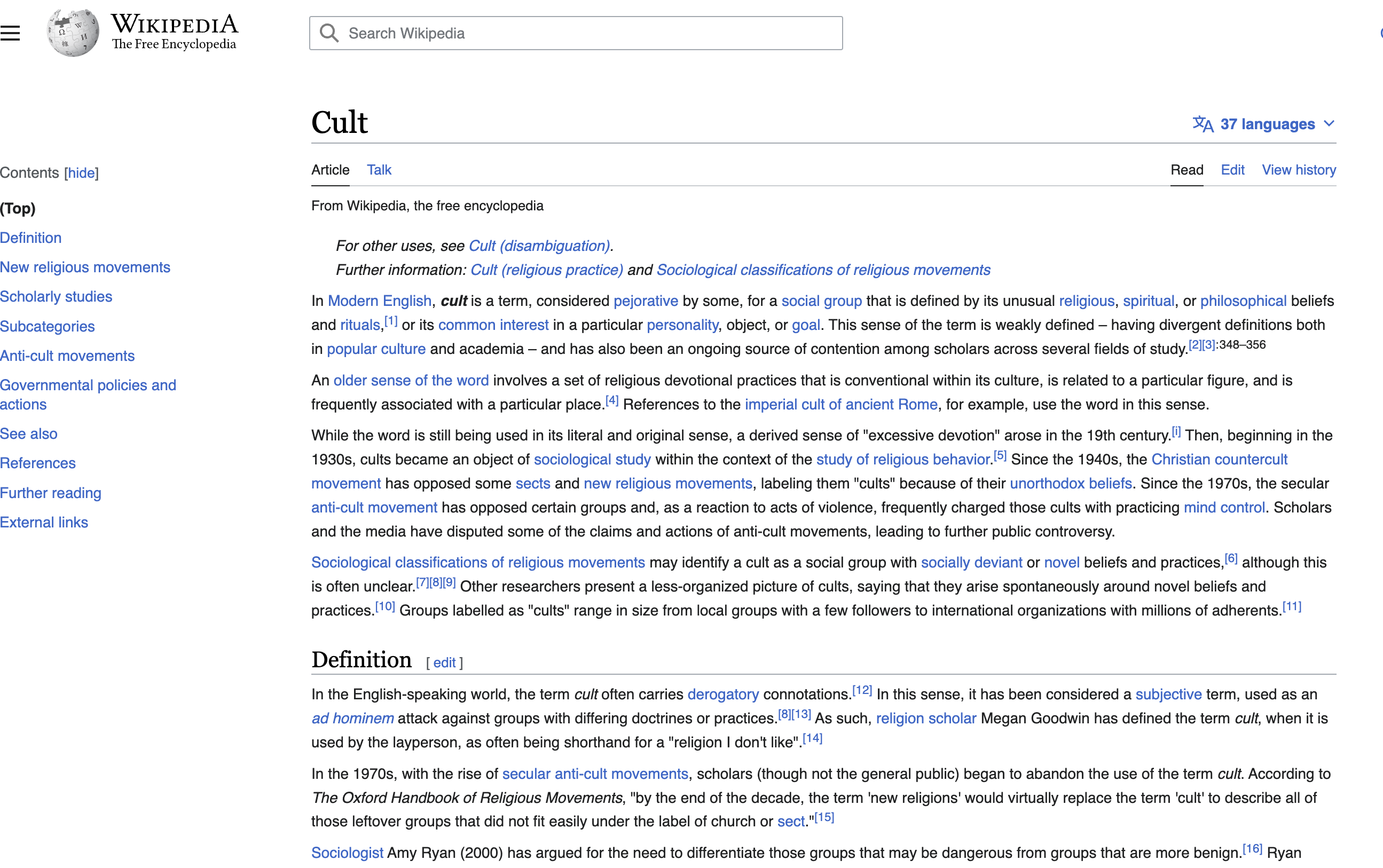
From a sociological perspective, the term ‘cult’ is problematic. In a 1993 Review of Religious Research article entitled “Definitions of Cult: From Sociological-Technical to Popular-Negative” Richardson provides deep historical background behind the usage of the term and ultimately advises that its use should be avoided by academics. The term ‘cult’ in popular culture is clearly intended to be pejorative and accusatory, typically inferring excessive control and blind devotion.

In the context of our survey where our intent is to hear and report what the respondents tell us, I think it is inappropriate for me to weigh in as to my sociological viewpoint at least as far as labeling the Adventist church a cult. That debate aside, the impact of this church on children can be an issue.  The Millennial respondent quoted above does, however, make a point that deserves greater attention. He said,

“This is particularly damaging to Adventist children and should meet the minimum legal threshold necessary to define some SDA practices as inherently abusive towards children, and yet it is somehow not defined or viewed that way socially or legally.” 

Many have argued that religious indoctrination is child abuse and that “Children have been terrorized with the threat of living an eternity in a lake of fire. That’s unequivocally been the source of nightmares and PTSD for millions of kids.” I am not going to disagree.

Your thoughts? Contact us: exsda@proton.me and/or arcaro@elon.edu.


Some preliminary data

“Thanks for doing this survey for us ex SDA. It is a rarity, never done anything like it, so specific, before.”

-male, Millennial, Ex-Adventist

Some preliminary data

‘Data teasers’
We opened the survey nearly two weeks ago on March 1 and are both pleased and thankful that so many ex-SDA folks have responded. Our research team was recently interviewed by Santiago, host of Haystacks & Hell, and we had the opportunity to provide some deep background behind our survey. We are happy that our modest efforts have generated some interest among ex-SDA people and that the survey is providing a cathartic experience for many.

Below are some ‘data teasers’, very preliminary results and comment on same. Enjoy!

Remarkable response rate
As of this writing (3-12-23) we have 336 responses to our survey with a remarkably high 100% completion rate. That means every person who started the survey made it all the way to the end, pressing the final ‘submit’ button. This rarely happens in online survey research and in this case likely means a highly motivated population of respondents. This interpretation is supported by many responses to Q62 “Please add any final thoughts about the survey, any of the questions we asked, or anything you think may be useful to our research team.” One respondent commented,

“Thank you for doing this work, sorry for the trauma dump but I think the data is worth sharing cos I know I’m not alone.”

The mean time spent taking the survey is almost 34 minutes and an unusually high number of respondents are making comments, sometimes 100 words or more. Every possible indicator tells us that those responding to the survey are deeply engaged and committed to sharing their stories.

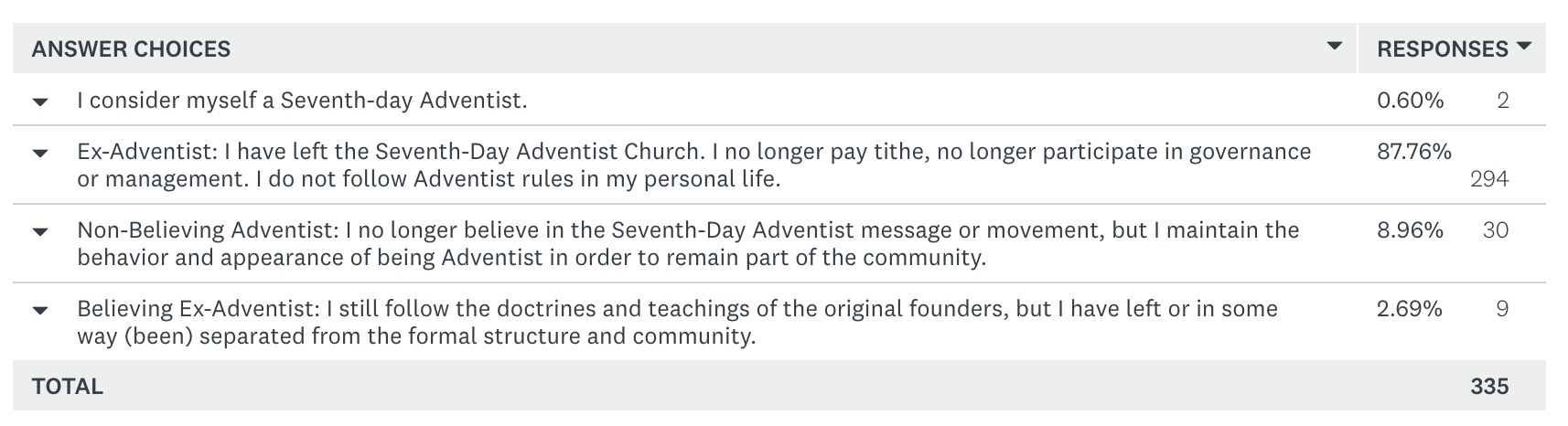
So, who’s responding to this survey? Question 1 asks, “What is your current relationship to Seventh-day Adventism?” The results thus far indicate the vast majority (88%) are indeed ‘Ex-Adventists” with a small but significant minority being physically in but mentally out (PIMO), i.e., “Non-Believing Adventists.” Over 91% of our respondents report they were born into Adventism.

Two word clouds
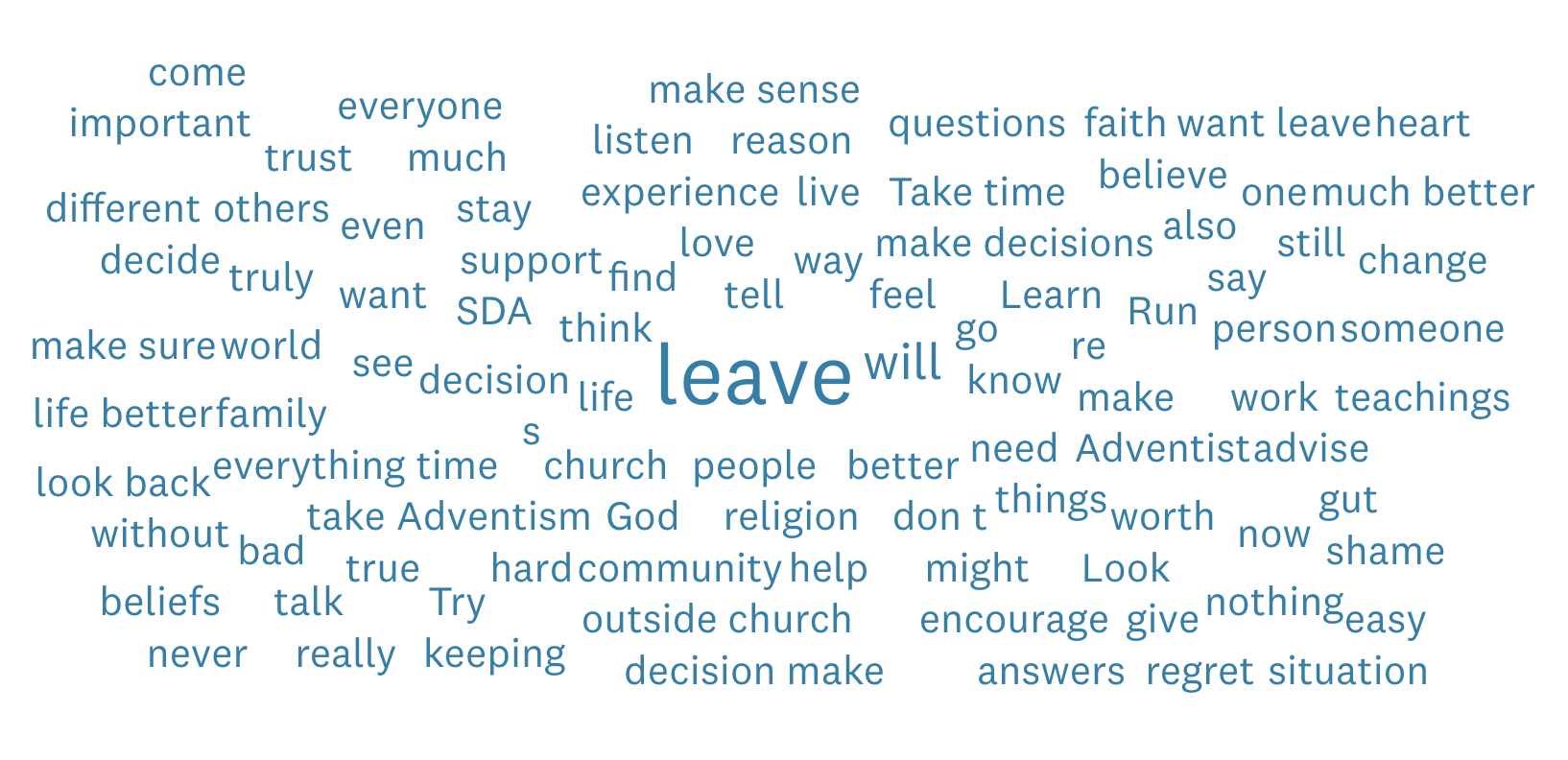
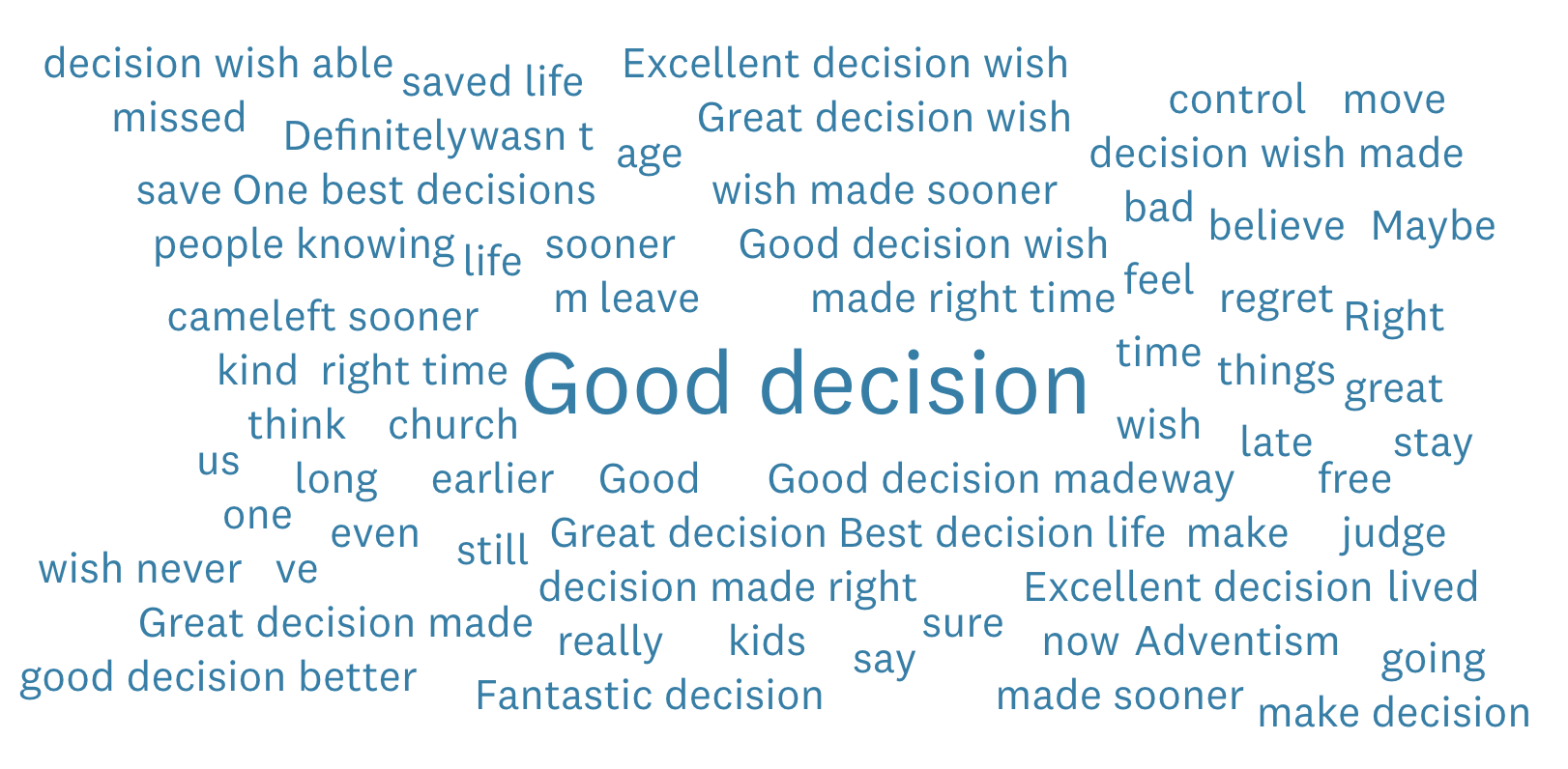
A word cloud is a visual representation of text data and the importance of each is shown with font size. Words that appear more often in the collective responses are bigger and help identify the focus of written material.

Q51 asked, “On balance, how do you now view your decision to leave Adventism? Good decision? Poor decision? Made at the right time?” Here is a representation of the 309 narrative responses thus far.

Q52 asked, “If you were to advise someone struggling with the decision to leave Adventism, what would you say to them?”  Collectively, 297 respondents said this.


Having read through all of the comments that went into both word clouds above I can report that the two messages, “good decision’ and ‘leave’ were amply and repeatedly stressed by the respondents. Here are three examples from Q51.

“It was one of the best decisions I’ve ever made in my life and wish I had made it sooner.”

“Great decision. I feel bad for people my age who still believe in it and are trapped in Adventism. I even wonder how in the world they still believe this baloney, with all the information out there on the Internet.”

“Excellent. The sooner the better.”

And now three examples from Q52.

“That leaving would give them a sense of overall peace and advise them to find other friends/support outside of the church.”

“That if they want to leave DON’T stay there just to please parents or by fear of family rejection. That’s being a hostage. Inner damage has begun at that point, and it is better to reduce the impact as soon as possible by leaving that place.”

“Leave. Run like the wind.”

Parsing through the data
The data so far provides a fairly clear picture of ex-SDA who have responded to the survey, and our job of parsing through all of the data has yet to begin; there is much to report. We will be keeping the survey open for a while but will not be able to avoid the temptation of sharing more ‘data teasers’ in the coming days and weeks. If there is a question that you would like to see the results for please let me know in the comments and I will respond with a post describing those data. In the meantime, please let us know if you have any feedback. I can be reached here or you can use this (ExSDA@proton.me) email as well.

Follow us on Instagram.

Follow us on Twitter.


One size does not fit all

One size does not fit all

[Updated 4-21-23]

Group positionality statement
As an elaboration on how we describe ourselves on The Research Team page, here is our collective positionality statement. All three researchers are middle class, straight, cis, white, and able males from and living in the United States. One of us is middle aged and the other two are older. Hence we all experience many privileges based on these ascribed statuses and even more due to our individual achieved statuses. All three of us are professionals, working in fields that thankfully hold a respected place in our culture. We are demonstratively not perfect in any way, but especially in terms of being fully aware of the many biases we hold. With grace, we strive both in our personal and professional lives to embrace the principles of diversity, equity, inclusion, and justice. That said, our current work, this survey, is also not perfect. We will accept your feedback with grace and hope to be given the same.

To this point, one respondent wrote

“Some of the questions in this survey didn’t have adequate options. Some of the questions seemed to be based on presuppositions about Adventism. Perhaps the folk who wrote the questions did not realize that Adventism is practiced very differently in different parts of the world. It felt like this survey was more relevant to people who grew up in North America and never experienced Adventism in other parts of the world.”

The Seventh-Day Adventist church has a demonstratively global reach “…with a membership of over 21 million in 13 regions of the world.” Yet this survey was written from the perspective of US citizens who grew up in North America and may indeed have that bias, excluding accurately capturing the nuances of the experiences of ex-SDA people from other parts of the globe. Perhaps most obviously, this survey (as of now) is only available in English and thus excludes the voices of ex-SDA folks who cannot read English. It is also available only online via the Internet, and so only those who have access to appropriate technology can easily respond. As straight, cis males, our questions may be biased or skewed from the perspectives of non-straight, non-cis, and/or females.

The question about race
That the three researchers are white also adds a critical layer of potential bias. In North America, for example, we are aware  there is a Regional Conference system: essentially a separation of white Adventist churches and Black Adventist churches within the same General Conference system. Beyond the US, we know that Adventism can be experienced in a very different way than in the US, especially by those in the (so-called) Global South, in sub-Saharan Africa or Southeast Asia, for example.

Near the very end of the survey we ask, “Which below best describes you?” and offer only two options, ‘white’ and ‘non-white’. The next question (which provides a comment box) asks, “Please use the space below to (1) react to the inappropriateness of the choices in the question above and (2) describe how you identify yourself based on common cultural-linguistic, ethnic, racial, tribal, national or other categories.”

The concept of race is clearly problematic, especially so on a survey intended to reach across the globe. One respondent noted that,

“White isn’t a useful term as it forces so many cultural identities into one term that was used by the british [sic] to colonize and remove the cultural identities of immigrant groups (especially in Australia) that they oppressed but pitched against the first nations people to help oppress them and create division.”

Indeed, quite bluntly, ‘race’ is a fairly modern concept which is classist and colonialist, created by those in power to justify slavery and other forms of social and economic marginalization. Now ossified into most of Western -and most certainly US- cultures- the ‘race’ concept has various context-dependent meanings and connotations.1 Which box, for example, would a Bangladeshi ex-Adventist tick off in a standard Western-based survey using what are arguably very culture-bound categories? Our intent with our two questions on race is to poke at the artificiality of the concept and then encourage respondents to self-identify “based on common cultural-linguistic, ethnic, racial, tribal, national or other categories.”

To illustrate this complexity, here is a comment made by one respondent from Brazil,

“In Brazil, I am considered white due to my appearance and the way society treats me. When I was in the United States, I was considered Latino. My paternal grandmother is indigenous and my uncles have indigenous phenotypic traits. Also, like most Brazilians, my paternal and maternal families are mixed. Thus, I find it difficult to answer when the options are merely White/Non-White. I also considered that this research is being done in the US, where I am clearly not considered white.”

One size does not fit all
Our survey -and subsequent analysis of the data- does not pretend to be void of biases nor to be seen as a ‘one size fits all.’ The survey and this blog are intended to be our most honest effort to hear and report on the voices of ex-SDA souls who choose to take the survey. Our hope is our efforts will begin a conversation among many, even well beyond just communities of former Seventh-day Adventists, about the process of rejecting church membership.

To those of you who think this project (the survey, our analyses) could be better, we welcome your suggestions! Please do give your feedback in the comments, here in the blog; send us email (exsda@proton.me and/or arcaro@elon.edu); or respond in the space provided within the survey itself. We do not promise to implement every suggestion, but we do promise to take each one seriously. Your feedback is welcome and encouraged.

We thank you for your feedback and hope you will join us in the journey of discovery, growth, and new perspectives on faith, reason, and what ‘Eighth-day Freedom’ entails.

****

Follow us on Instagram.

Follow us on Twitter.


1. In a 2019 article titled “A Global Critical Race and Racism Framework: Racial Entanglements and Deep Malleable Whiteness sociologist Michelle Christian expands on the idea that “...the processes of deep and malleable global whiteness that has sustained global white supremacy.” She argues for a Global Critical Race and Racism (GCRR) framework which helps us understand how race and racism have emerged from and been sustained and deepened by colonialism and post-colonial entanglements.  She writes,

“…racism is always “transforming” (Goldberg 2009) and “on the move” (Wade 2015), embedded in historical moments, geographies, and other markers of difference while still being entrenched in a continuum of white dominance and racial subordination (Weiner 2012).

In essence, Christian’s GCRR framework provides support for the ‘white’ ‘non-white’ choice survey respondents were offered in our survey.

Leaving the church

Leaving the church

by Duane McClearn

I have spent considerable time over the past many years pondering religious believers and religiosity, atheists and atheism, and, of particular relevance here, former believers, their reasons for leaving their faiths, and the consequences of doing so. My knowledge comes primarily from extensive reading and conducting surveys on these subjects.

I came away with many messages from a survey that I conducted several years ago with Tom Arcaro (colleague on the current ex-Seventh-day Adventist project). Thousands of atheists wrote of their experiences, many of whom were recent converts away from Christianity of one denomination or another. A large number spoke of the emotional conflict they had within themselves trying to come to terms with the fact that they felt they were losing belief in their religion—many thought of themselves, at least in the beginning of the process, as traitors to the cause, to their parents, their extended families, their communities. Their whole identities were at risk. When they started the process of breaking free, often there was great resistance from the church leaders and members, their families and friends, their spouses. Their stories were often quite poignant. But for many, the going was not as tough—they slid into non-church-going, atheist status rather painlessly, maybe by stages, perhaps with support, or at least not resistance, from family members.

Once they made the transition from in the religion to out, these self-declared atheists described themselves overwhelmingly with words like “free,” and “liberated,” and “non-oppressed,” and “independent.” Were there downsides of leaving the church? For many, none at all. For some, there were. These were mostly lost friendships (people who were still religious who broke off the relationship with the person who left), pleasurable social functions (church picnics and such), and certain rituals. But for the most part, and I mean by far the most part, those who left were glad that they did, some indicating that they only wished that they had done so much earlier.

Of course, the issue of leaving the church is of major importance to church leaders across the US. Christian denominations are hemorrhaging members as I write. (And here I confine myself to writing about Christianity, and not other religions.) A recent Pew Poll (2021) on religion found that the percentage of Americans identifying themselves as Christians had dropped to 64, while the percentage classified as “none” (a catch-all category including atheists, agnostics, and “nothing in particular”) rose to 30, its highest level in years. Current Pew projections estimate that the “nones” will be as much as 52% of the population by 2070. It is no wonder that church officials are worried and trying to stanch the flow. In any case, for the people who are leaving the church, any church, you have a lot of company.

This blog is devoted to giving ex-Seventh-day Adventists a place to speak out and be informed. My colleagues and I imagine that members of the SDA church experienced an environment that was different, perhaps more “extreme,” than the typical Christian church in America. Does the typical Adventist, in fact experience a more “intense” Christian experience? Do the members who leave SDA suffer more anxiety, guilt, shame, or conflicted emotions than other Christians who quit their denominations? Do ex-SDA feel a greater sense of freedom upon breaking loose from their church? As far as I (and my colleagues in this project) are aware, nobody has given a voice specifically to ex-Seventh Day Adventists. It was our desire to allow them a forum to speak about their SDA experiences and hear from other ex-members. It is our hope that the comments will mirror those ex-Christians discussed above, in terms of expressing feelings of freedom, independence, and other good emotions.

*****

Follow us on Instagram.

Follow us on Twitter.